the sea swallows
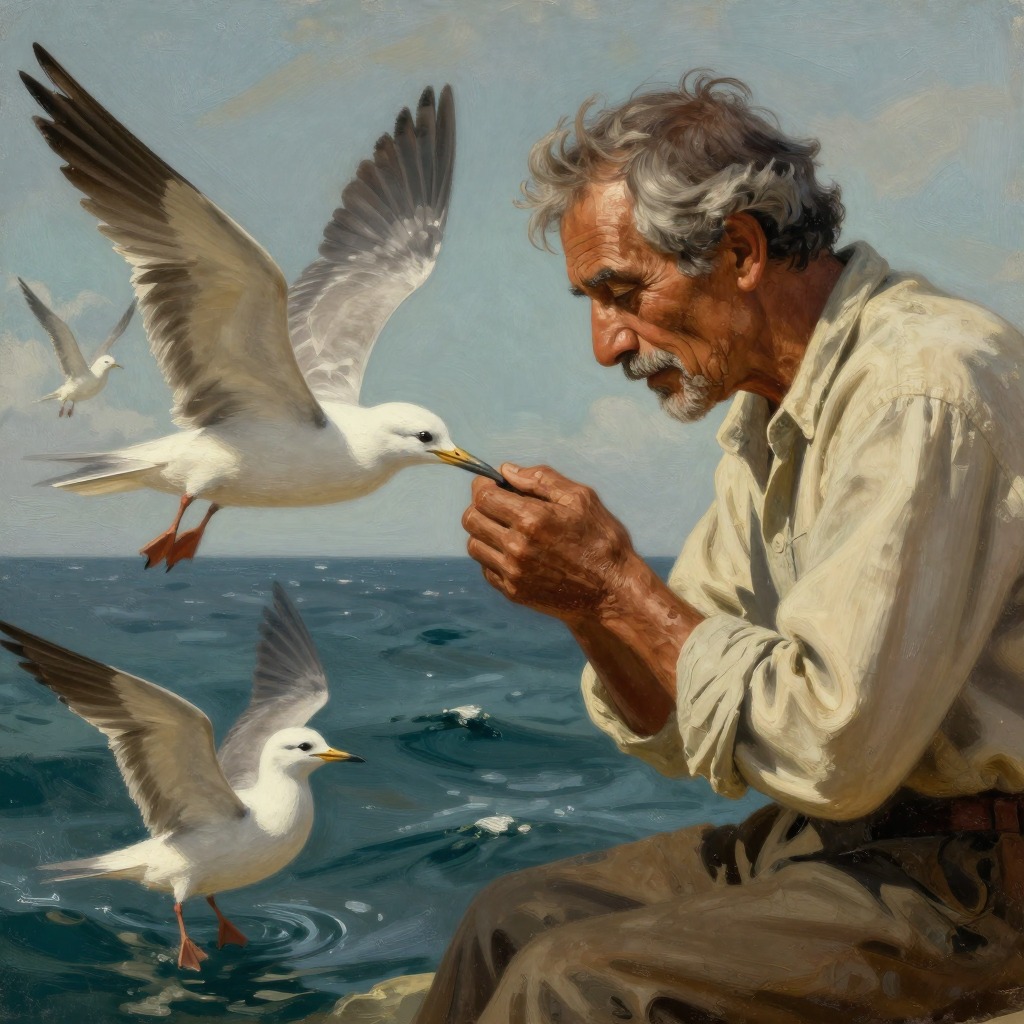
The sea swallows are the small, delicate dark terns that Santiago, the old fisherman, observes and pities during his solitary voyage on the Gulf Stream. They appear in the narrative as a concentrated emblem of vulnerability, standing in contrast to the robust predators of the sea and to the old man's own weathered endurance. Santiago's compassion for these birds reveals a central dimension of his character: his capacity to see the ocean not merely as a contestant or a resource, but as a living system in which some creatures are made too fine for the harshness they must endure.
Identity and Appearance
The sea swallows are introduced as "small delicate dark terns" that are "always flying and looking and almost never finding" food. Santiago notes that they have "small sad voices" and are built with a fineness that seems mismatched to the environment they inhabit. The old man reflects that the ocean, which he thinks of as feminine and calls la mar, can be "kind and very beautiful" but also "so cruel" and that "it comes so suddenly." The sea swallows, in their delicacy, are "made too delicately for the sea." This observation is not a passing remark but a sustained meditation that Santiago returns to while rowing, linking the birds' plight to his broader understanding of the ocean's dual nature.
Santiago's Compassion and the Hierarchy of the Sea
Santiago's pity for the sea swallows is part of a larger pattern of sympathy for the weaker inhabitants of the ocean. He is "sorry for the birds, especially the small delicate dark terns," and contrasts them with "the robber birds and the heavy strong ones" that fare better. This hierarchy—delicate versus robust—mirrors the old man's own position: he is old, thin, and scarred, yet his eyes remain "cheerful and undefeated." The sea swallows, by contrast, have no such inner resource to draw on; they are simply too fragile for the world they must navigate. Santiago's pity for them is therefore also a form of self-recognition, though he himself possesses a will that the birds lack.
The Sea Swallows and the Ethics of Killing
Later in the narrative, when Santiago has hooked the great marlin and is enduring his long struggle, his thoughts return to the ethics of killing and the nature of the creatures around him. He reflects that "it is good that we do not have to try to kill the sun or the moon or the stars" and that "it is enough to live on the sea and kill our true brothers." The sea swallows, as creatures too delicate for the sea, stand at the opposite end of this ethical spectrum from the marlin, which Santiago calls "my brother" and kills with a mixture of love and necessity. The swallows are not killed; they are simply allowed to struggle, and Santiago's pity for them is a form of acknowledgment that not all suffering in the natural world is a contest of wills. Some suffering is merely the result of being made too fine for one's environment.
Thematic Significance: Fragility and the Natural Order
The sea swallows function as a thematic counterpoint to the dominant motifs of strength, endurance, and victory in the novella. While Santiago's story is one of heroic struggle against a great fish and against sharks, the sea swallows represent a different kind of truth: that the ocean is not a fair arena, and that some of its inhabitants are born to lose. The old man's pity for them does not diminish his own resolve; rather, it deepens the reader's understanding of his character as someone who sees the world clearly, without sentimentality but also without hardness. The swallows are a reminder that the sea, for all its beauty, is a place of casual cruelty, and that the old man's own survival depends on a toughness that these birds do not possess. In the end, the sea swallows remain a quiet, recurring image of the cost of living in a world where even the most delicate are subject to the same vast, indifferent forces.